Una ruta cultural por la historia, las tradiciones, la gastronomía y la naturaleza de diez enclaves patrimoniales por el interior de Andalucía
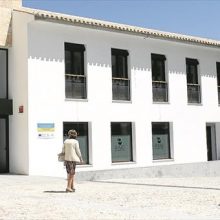
The Priego de Córdoba wholesale market is located in a historic-patrimonial setting given that it is situated next to the Carnicerías Reales (Royal Slaughterhouse) building. Inside you will be able to find various stalls with: bread and artisan products, greengrocer’s, butchers, fishmongers, chicken rotisserie stall open at weekends, pizzeria, beauty centre, handicrafts store and a bar. There is also a car park with direct access to the market to make shopping easier. The market’s opening hours are from 7.30 am until 11 pm (the stalls are open during normal trading hours).
This hospital and its church were founded in the 17th century by Juan de Herrera, and dedicated to San Onofre. It was initially renovated by Francisco Hurtado Izquierdo, although the artists Jerónimo Sánchez de Rueda, Juan de Dios Santaella and Francisco Javier Pedrajas later left their mark.
san juan de dios, Priego de Córdoba
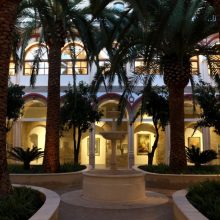
The building adjoining the church of San Pedro Mártir de Verona was the former Dominican convent founded in 1575 by the Bishop of Cordoba. In 1836, it became a national asset as a result of the decree of expulsion. It was auctioned in 1844 and Juan de Navas García took ownership of it. Before becoming municipally-owned, the building was an anise distillery, olive oil mill and winery. It still features a fantastic Mannerist arcaded courtyard with semi-circular arches and columns on a pedestal base. There is a fountain in the middle surrounded by a garden and palm trees. The building is currently being refurbished and will be turned into a multi-purpose public centre. The project has restored the central porticoed courtyard and a second rear courtyard has open green spaces for everyone’s enjoyment. The rest of the building has a versatile design for different uses, including exhibitions, teaching, social uses, meetings, etc., with a total of 11 rooms spread across three floors.
C/ San Pedro, 50, Lucena
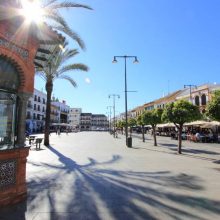
Despite the square’s recent renovation, some of the neighbouring buildings preserve 17th- and 18th-century elements. In the past, Plaza del Altozano was the epicentre for the town’s cultural events, such as famous bullfights and the passing of religious processions (very much like today). Given their privileged position and unbeatable views over the square, the surrounding properties are sought after and their balconies are used as private boxes during the town’s festivities.
plaza del altozano, Utrera
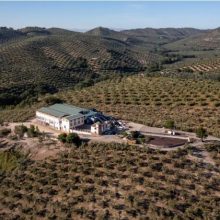
Elia Oil Company is located in one of the most emblematic buildings in the region, in Priego de Córdoba, a classic Andalusian farmhouse from the 19th century, at the foot of La Tiñosa, the highest point in the province of Córdoba, in the heart of Parque Nature and Geopark of the Sierras Subbéticas. The mill was launched in 1994, its main objective being the search for the highest quality, promoting the culture of oil and respecting the landscape of the wonderful enclave in which we are located. The best way to learn and enjoy oil is to get lost in the olive groves and feel it up close, appreciate where it comes from, feel its perfume and appreciate its nuances, which is why our facilities are equipped to receive visitors, enjoy the surroundings and our products. . The best professionals and oleologists will show you why Nuve Olivo is a high-altitude oil, a unique oil, they will explain why the special characteristics of the soil and our centenary olive trees give our oil a unique personality. It is essential to make an appointment. The reception in the olive grove will take place whenever the weather conditions allow it. Services: The […]
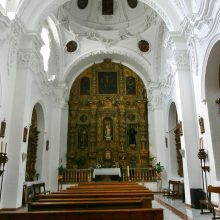
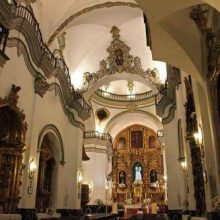
This church was built in 1718 by Jerónimo Ramírez de Quero in line with Leonardo Antonio de Castro’s designs, an artist from Lucena of great renown. The church has a rectangular floor plan and a remarkable side with five sections, covered with a half barrel vault, except for the section next to the presbytery, which boasts a dome atop pendentives embellished with complex leaf forms around the founders’ heraldic coat of arms. The façade consists of ashlars, formed by a rectangular wall, crowned by a triangular pediment with an oculus, mirroring models inspired by the Herrerian style. The main altarpiece, dominated by the image of the Inmaculada, was constructed in 1800.It shows clear Neoclassical influences in its structure and is organised into three traditional tiers: a very elevated, lower bench, including beautifully carved and gilded geometric-style sacristy doors and a Sagrario, topped by a straight pediment, the main tier and the attic tier.It possesses many sculptures, one of the most remarkable being San Miguel, which is possibly of colonial origin.
antonio eulate,19, Lucena
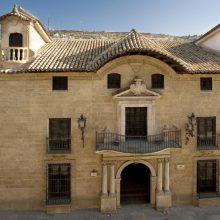
The ancient Abbey Palace was reconstructed in 1781 by the Abbot Esteban Lorenza de Mendoza y Gatica, given the state of ruin of the original palace within the Fortaleza de la Mota. The new building was the end result of the aggregation of several structures, brought together by the single façade. This building was used until 1851, when the Abbey of Alcalá la Real was abolished. After years of uncertain future, it became the abbey archive and the home of the Archpriest of the Ecclesiastical Territory. Currently, and after years of restoration, the Abbey Palace is the headquarters of the Municipal Museum. This new museum was created to display, preserve and promote archaeological, ethnological, anthropological, paleontological and scientific exhibits organised into different display areas using the latest technologies.Through innovative means, the museum allows visitors to become better acquainted with Alcalá la Real’s heritage and traces of its past. It gives visitors the chance to have an overview of the town’s peculiarities, places of interest and its surrounds. Exhibition spaces: The flour room (dedicated to flour mill traditions), geology, minerals and fossils, Paleolithic, Neolithic, Copper and Bronze, Iberian world, Roman world, medieval, etc.
C/ Carrera de las Mercedes, 31, alcala la real, jaen
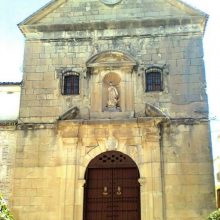
Although it was founded in the 16th century its fundamental structure is from the 17th century. It was an annex of the convent ruled by the brothers of the Order until 1835. The portal, stone carved, sober, presents the image of San Juan de Dios. Inside we can observe a single nave with a groin vault and dome at the end, the developments of its abundant cornices being very significant. The beautiful altarpieces are also noteworthy.
C/ José de Silva, s/n,Cabra
This ancient convent was built in the mid-17th century and can be found to the south of the Parque de los Álamos. After 1835, with the Ecclesiastical Confiscations of Mendizabal, it was converted into private housing and an olive oil factory. The Renaissance façade was modified with an artistic double flight of steps and wide windows. On the interior, only the basic church structure remains, which consists of a single nave with side chapels and a vestibule at the atrium. It is currently the home to the Archive and town library.
C/ Obispo Ceballos, 1,Alcalá la Real
Built on the site of the ancient hospital “Del Dulce Nombre de Jesús.” Its construction started in 1630, which lends to its current appearance.
C/ Carrera de las Mercedes alcalá la real
 English
 Español
 Français
 Deutsch