Craftsmanship in Caminos de Pasión: heirs to a constantly evolving heritage
Craftsmanship is a form of knowledge, born from history and art, that preserves manual labor in a largely industrialized world. Numerous workshops exist in the towns along the Camino de Pasión (Paths of Passion) routes, which have, over the centuries, provided a material heritage to the brotherhoods and confraternities that are part of their history and shape their unique character. In the artisan workshops of these ten towns, pieces of great artistic value have been created that have traveled to corners of the entire country, and even to parts of Europe.
Undoubtedly, crafts are a living heritage that serves as a hallmark of the various celebrations and their unique characteristics, which in some cases have evolved over time, giving rise to contemporary artistic expressions. Embroidery, wax figures, sculpture, religious imagery, gilding, metalwork, clothing, ritual offerings, and musical instruments are just a few examples.
ALCALA LA REAL
The mimed, staged, or proclaimed processions are the defining characteristic of Holy Week in Alcalá la Real . These processions are theatrical representations performed by figures wearing masks or "face coverings" and colorful costumes, accompanied by town criers who shout out poignant chants with unique melodies, a blend of poetry and prose, passed down through generations, and accompanied by the wailing of trumpets. Although Alcalá la Real was the birthplace of the sculptors Pablo de Rojas and Martínez Montañés, great masters of the Andalusian school of Baroque sculpture, the artisan tradition that still thrives in the city is linked to textile crafts. Two artisan workshops stand out: Artesanía Florencia, dedicated to mantillas and tulle embroidery, and the Embroidery Workshop of the Brotherhood of Hope.
BAENA
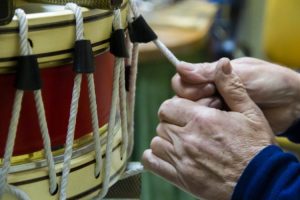
Holy Week in Baena is a Festival of National Tourist Interest . Rich in ritual, it features both processions and reenactments of biblical passages. Its most distinctive feature is the figure of the Jew—with either a white or black tail—and his drum, whose rhythm was declared an Intangible Cultural Heritage of Humanity in 2018. The Jews accompany all the processions and liturgical acts that take place during Holy Week in Baena. Around this figure, various local crafts have developed, maintaining ancient traditions related to the making of the Jew's costume, the metalwork of the Jew's helmet, and especially the making of his drums. Three workshops can be found in Baena: Baena Sonido and Enrique Luque Luque, both dedicated to the production of handcrafted drums; and the Nucete Brotherhood Shop, specializing in Holy Week items and embroidery.
GOAT

Declared a Festival of National Tourist Interest , Holy Week in Cabra boasts an ancient tradition and is notable for having 29 penitential brotherhoods and confraternities. Among the unique features that enrich its celebration are the Jewish and Roman traditions, the sound of the añafiles or 'bee-eaters' (long, low-pitched trumpets that sound each time the float is raised), the drumbeat known as 'rompevelos' (veil-breaker), and saetas (religious songs). Cabra is home to two important artisan candle makers, Cerería Hermanos Lara and Velas Ridaura, which supply candles, wax floral art, and votive candles to numerous churches and celebrations, both regionally and nationally.
CARMONA
During Holy Week in Carmona , the city's own monumental architecture provides an exceptional setting for the processions of its eight brotherhoods. Its remarkable heritage of sacred silverware and religious imagery is particularly noteworthy, including the oldest dated piece that participates in the Holy Week processions in Andalusia: the Lord of Sorrows (El Señor de la Amargura) , created in 1521 by Jorge Fernández Alemán. Among the crafts associated with Holy Week, the meticulous work of preserving its outstanding brotherhood heritage is particularly remarkable, especially regarding embroidery, woodwork, and gilding. The city also houses the Art and Restoration Studio, where conservation and restoration work on works of art is carried out. The work of two local sculptors with their own workshops, Miguel Ángel Valverde Jiménez and Miguel Ángel Villa Pérez, is also of great importance.
ECIJA

In Écija , Holy Week is renowned for its Baroque style and the beauty of its floats and religious images. The sculptures, created by renowned artists such as Juan de Mesa, Montes de Oca, and Gaspar de Águila, among others, boast centuries of history. Fourteen brotherhoods participate in the penitential processions. The embroidery workshop of Jesús Rosado Borja is a treasure not only for the historic palace it occupies, but also because it preserves the traditional embroidery techniques used for sacred art, as well as the materials used for processional floats and sculptures. Furthermore, it has become a symbol of contemporary art and innovation, applying its designs and work to haute couture for brands like Dior. Écija is also home to the sculpture and religious imagery workshop of Jesús Richarte.
LUCENA

The most distinctive feature of Holy Week in Lucena is 'La Santería,' a unique tradition characterized by the distinctive way the floats are carried, coupled with a magnificent wealth of religious imagery. The images are borne on the shoulders of the 'santeros,' dressed in robes with their faces uncovered, adhering to strict rules of respect and solemnity, marching to the sound of 'El Torralbo,' which announces the arrival of some processions, and the beat of a drum. The goldsmithing and bronze workshops of Lucena are highly prestigious, with the Lucena candlestick as the most characteristic piece and symbol of the city. Their sacred art adorns the floats of many Holy Week processions, belonging to brotherhoods both within and outside of Spain, and their candlesticks and ornaments are distributed internationally. The sculpture of the artist Francisco Javier López del Espino is also noteworthy, not only for his religious works but also for his contemporary pieces, which have been recognized with various national and international awards and accolades. Among the workshops dedicated to goldsmithing and bronze, we find: Angulo Bronzes Goldsmiths, Juan Angulo Goldsmith, Gradit Goldsmiths, Paula Goldsmiths and Durán Bronzes.
OSUNA
During Holy Week in Osuna , the immeasurable value of the exquisite sculptures that comprise its religious imagery stands out, crafted by artists such as Juan de Mesa, Vicente de Tena, and José de Mora, among others, combined with the dedication and passion of its people. All of this transforms this celebration into a solemn spectacle. Osuna maintains a strong artisan tradition linked to these customs, such as sculpture and restoration, with the woodcarver José Carlos Ligero as its foremost representative.
PRIEGO OF CORDOBA
Holy Week in Priego de Córdoba boasts magnificent floats and extraordinary sculptures. The solemnity of its processions contrasts sharply with the popular outpouring of the Good Friday ritual, where countless people yearn to be beneath the platform carrying the Nazarene to Calvary, where he will bless the thousands of traditional Easter pastries carried by devotees. Priego is home to excellent artisans, particularly a group of professionals dedicated to carving and sculpture, especially religious imagery, and related crafts such as gilding and restoration. Among them are the workshops of the Cubero Brothers, specializing in sculpture and religious imagery, and that of Antonio Manuel Serrano Ávila, a specialist in carving, gilding, sculpture, and restoration.
BRIDGE GENIL

Locally known as 'La Mananta' , Holy Week in Puente Genil represents one of the most unique expressions of popular religiosity. Its most original and representative element is the more than 400 biblical figures that parade alongside the 24 brotherhoods, each representing characters from the Old and New Testaments , as well as religious symbols and allegories. Local crafts are mostly related to Holy Week, particularly the making of masks for the biblical figures and the accessories needed for their characterization, such as badges, shields, diadems, helmets, swords, and scepters. Among the workshops are those of Jesús Gálvez Silva, dedicated to making masks; Siglo Barroco, specializing in religious imagery and metalwork; Javier Aguilar Cejas, an expert in Holy Week painting and posters; and Vicente Estrada Rivas, specializing in wood carving. and Clemente Rivas Jiménez, dedicated to painting, sculpture, and goldsmithing. Also important is the presence in the town of the only artisan in the country dedicated to the creation and restoration of feather headdresses and plumes, led by Antonio Delgado Ruiz.
UTTER
During Holy Week in Utrera , a total of 13 brotherhoods participate in processions, showcasing the religious and artistic legacy of their brotherhoods, some of which were founded between the 16th and 18th centuries. Utrera's artisan tradition is largely linked to its religious festivals, with workshops specializing in sculpture, gilding, and embroidery. Notable among these are the embroidery workshop of Inmaculada García-Rayo, a specialist in embroidery and textile restoration, and the sculpture and gilding workshop of Encarnación Hurtado. Painting also holds a prominent place in contemporary religious art, with artists specializing in Holy Week posters approaching the subject from an innovative perspective, combining cutting-edge techniques, as is the case with the artist Antonio Rodríguez Ledesma.
Header photo: Inmaculada García-Rayo Embroidery Workshop, Utrera